Bridge Banshee grab
Posted April 8th 2016, updated later
Associated movies
- BCM175 - Heroic; Bridge Banshee hunt (5:49)
- BCM176 - Legendary; Segmented PAL speed run in 5:47 using a Banshee grab (6:12)
- BCM177 - Legendary; PAL speed run in 5:54 using new Banshee grab method (6:19)
- BCM191 - Legendary; Arch method breakthrough (8:06)
- BCM199 - Mostly Heroic; Ten amusing episodes (4:24)
- BCM205 - Mostly Heroic; Ten more amusing episodes (4:22)
Introduction
On Heroic and Legendary there's a marauding Banshee encountered at the first bridge - the 'bridge Banshee' as I call it - and remarkably it's possible to get the pilot ejected to grab it for your own use! There are multiple methods, but here I'll focus on the one I developed, which I called the 'arch method'. There's also Sligfantry's rim method which I originally detailed on this page, but which I've now (June 2026) moved to a separate page along with some other grab-related material.
Brief history
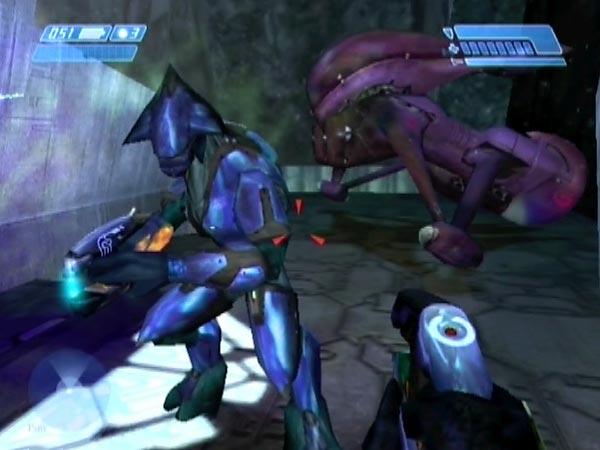
It was Sligfantry who started the Banshee grabbing business. He first mentioned the pilot ejection possibility to me in an email, though without disclosing how he'd done it. Naturally this caused me to go feverishly Banshee hunting for myself, because this was something big! After some effort I did find a way to get the Banshee, and it actually turned out to be different from Sligfantry's method when he revealed it. But in both cases, ejection occurs when the Banshee tips over too far, a phenomenon already known (e.g. see BCM171).
After Sligfantry released his tutorial on April 3rd 2016, I showed my successful Banshee hunt in BCM175 (see the first two pics here), and then came BCM176 showing the method (as it then was) used in a segmented speed run, to demonstrate the potential. Of course, this Banshee grabbing business was going to be highly relevant to speedrunning, because a prompt grab would allow a much faster time - something I highlighted in a forum post, estimating a time-saving of perhaps over 50 seconds.
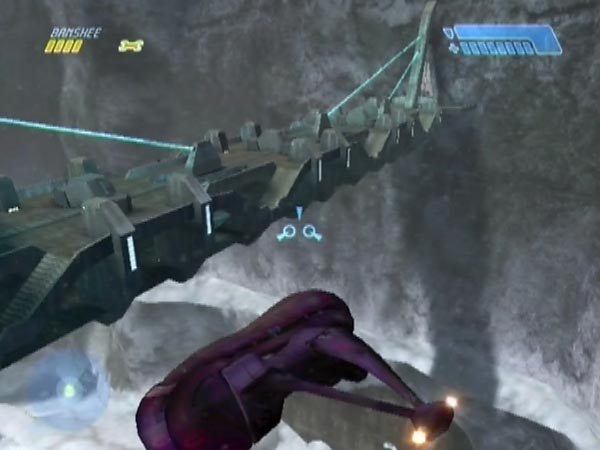
Partly with that in mind, I refined my method, bringing better control and making it viable enough for use in an actual speed run, though the odds of success were still quite low at this point. By way of demonstration I released BCM177 on April 13th: the first speed run using a Banshee grab, and presumably a PAL world record - except only an unofficial one as the speedrunning world sadly doesn't maintain a separate PAL table.
But later when I did some more investigation, I made a breakthrough which rocketed my success rate as high as 85%! I showed the new refined method in my definitive tutorial BCM191.
The relatively high reliability was obviously appealing to speedrunners, and made the method rather popular. At the very end of 2017 GarishGoblin used it in setting a new world record of 4:41, and also a full-game record of 1:14:45. Sligfantry's rim method is potentially a few seconds faster I should say, but not as reliable (or not so far at least).
Note: actually, Sligfantry had noticed the possibility of the Banshee getting into trouble at the arch. But he'd encountered this in a problematic form, which is what led him to focus on the rim instead.
Uses of a grabbed Banshee
A grabbed Banshee can be used in various ways, but for starters you could have some novel fun killing the bridge troops, though you'll need to do a bit of low flying to trigger the ones in the second half of the bridge. You could also drop yourself off on the Pelican to have fun trying to ride it down!
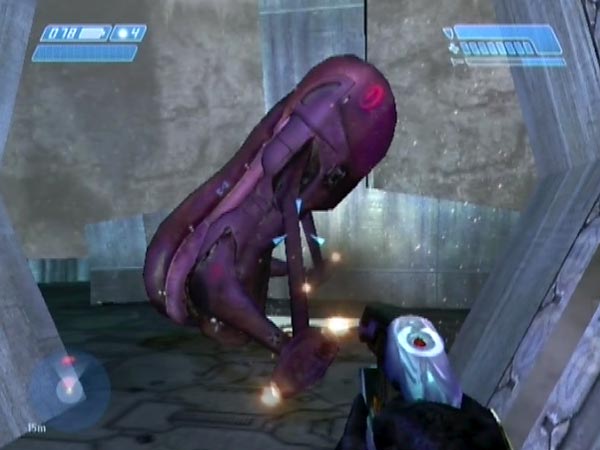
Of course, the Banshee can be used for tackling ground troops later too. But also, you can make use of the grab to easily get seven extra Marines, as seen in BCM241, and then (see pic) you can enjoy fighting the first ground battle with a squad of ten Marines instead of the usual three! See BCM315 for further examples of such battles.
Grabbing the Banshee also lets you descend from the bridge of course, so it gives a rather novel bridge descent method, should you wish to use it like that. But unlike all other methods of getting off the bridge, you have complete freedom of movement, so you might not even need to go down to the ground. In the past, many uses of descent methods have been to enable you to then fetch a Banshee and do some novel stuff. But nowadays (on Heroic and Legendary) you have the option of simply grabbing the bridge Banshee!
One other application of the grab is in getting the Banshee for a vehicle collection. Actually there's another way of doing it anyway, but doing a grab would be much easier.
Note: Some of my site articles need updating to take the Banshee grab possibility into account, as an alternative way of doing things. It's going to take a while before I work through them all.
Arch method
The basic idea for the arch method is to make the Banshee circle around into the gap at the top of the arch after its first attack run, and then when it squeezes in, tempt it into angling down and coming after you, in such a way that the pilot gets ejected. With sufficient finesse you can get a high success rate. I've managed as much as 85%, measured over 20 tries from a checkpoint prior to the loading point. You can see the method demoed in my tutorial BCM191, but here I'll describe the method in detail, step by step.
Incidentally, things seem to work the same on NTSC/PC as they do on PAL Xbox (my own system). I'm judging that partly from feedback in a HaloRuns thread, and partly on seeing the method used in speed runs.
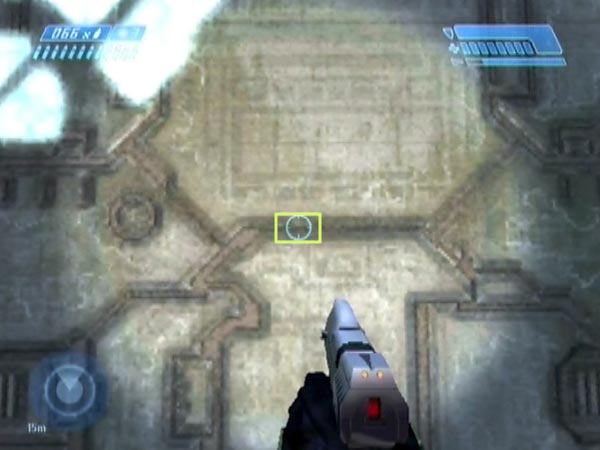
Get positioned
Preferably have a pistol and at least one grenade. Also a plasma weapon if you might be wanting to kill the pilot before boarding.
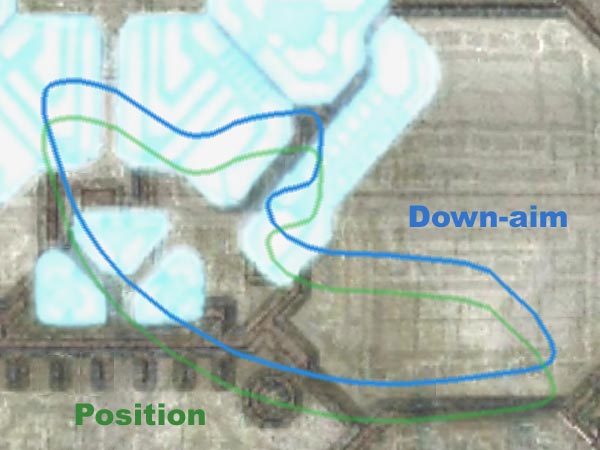
When you arrive at the bridge, advance a few steps beyond the door and position yourself using down-aim as shown in the picture. Facing the wall, target the small indicated area - part of a thick line below a faint 5 x 2 grid pattern to the right of the bright arrow. You don't have to be dead centre, but consider the centre optimal and try to at least have most of the pistol reticle inside the target.
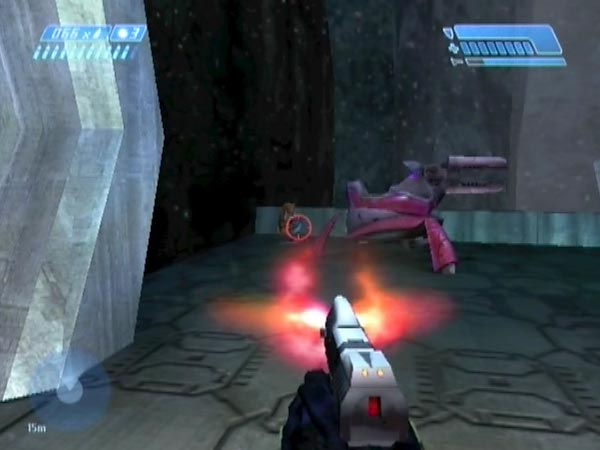
Kill any Grunts
Next, you'll normally want to kill any Grunts by the Shades, ideally with pistol headshots. If you're playing with headphones, you can know the situation without looking, because when you come through the loading point you can potentially hear them spawn, plus you'll usually hear them subsequently while getting positioned.
If there are two, I recommend dealing with the guy on the right of the bridge first, because then after swivelling to deal the other, you only have to swivel a little to focus on the Banshee. It's just an efficiency thing. That said, there's plenty of time to do the killing, as long as you didn't take too long getting into position.
Typically the Grunts on the other side of the wall panic after your pistol fire and won't immediately bother you. But sometimes one might arrive to man the left Shade, and may need dealing with. I'll elaborate on that in a moment.
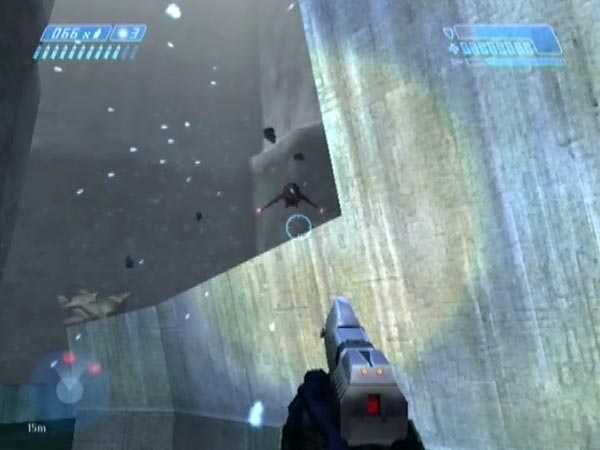
Crouch at the right time
Reserve your main focus for the Banshee because there's some critical timing needed. You need to do a brief crouch to make it veer off at the right moment, to try and make it circle into the arch gap. It veers off because you've become too obscured. Crouch as the tip of the Banshee's right wing is reaching the vertical shadow-line seen on the distant cliff. You have to get the timing just right, but with practice you can get arch entries with high success rate.
Arriving Grunts
In regard to Grunts arriving, it's worth glancing at your tracker when time permits, to get warning; and if one turns up, try to kill him if you think he can't just be ignored.
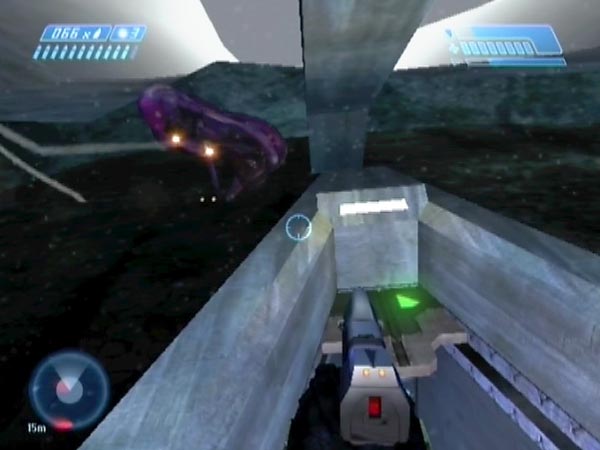
If he's arriving early enough, you can potentially do it before switching your attention to the Banshee, but don't end up compromising your crouch timing. It's usually best to wait until after the crouch. At that point you've got a good few seconds for a possible headshot - which is particularly easy if he's hopped onto the Shade but hasn't rotated it yet. Alternatively you could throw a quick grenade, being careful not to blast the Shade your way. Be sure to turn your attention back to the Banshee in time for its arrival at the arch though.
Just after crouching is a good time to glance at your tracker if you haven't already got a Grunt on the scene. If you see an approaching dot, make a decision about handling then focus on the Banshee.
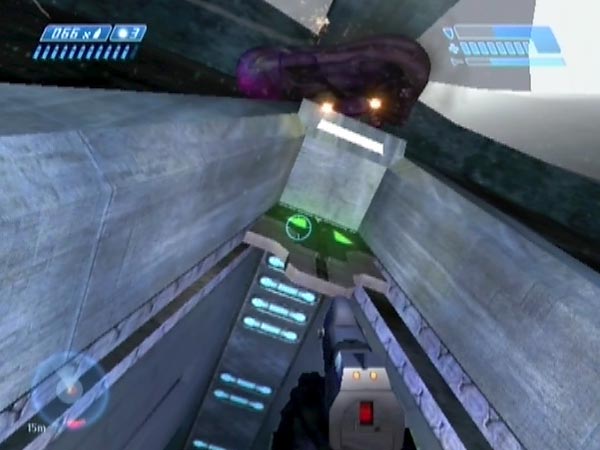
Arch entry and ejection
Remain in position and wait for the Banshee to hopefully circle around to the arch. If you see it enter the gap at the top as desired, move in towards the door opening, on the left; no further than the front of the frame. At this point you should be nearly underneath the Banshee, but slightly to its right, and behind the nose (be careful not to move in ahead of the nose or the Banshee is liable to back out).
It tends to pause for a moment, but then starts to angle right and downwards to come down after you. When you see this starting, move across towards the other side of the door frame (you can even go beyond, though there's no need) to try and strain the Banshee, making it turn more. Done well, this countermove should get the pilot ejected. The ejection happens early if at all, and I think it relates to the sloping beam of the arch contacting the Banshee, helping to tip it over as it turns.
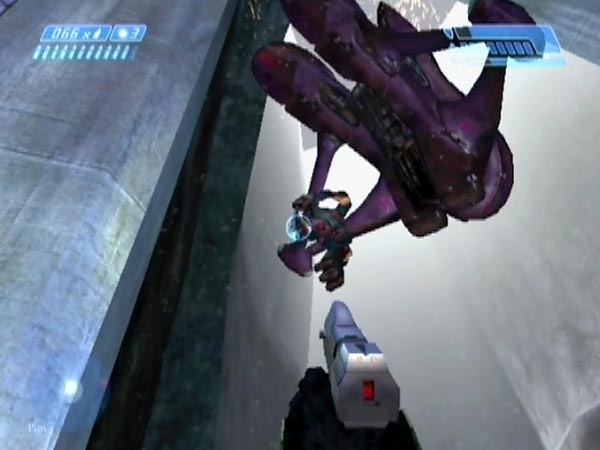
Let me emphasize something. Don't start moving across before the Banshee starts moving. If you get ahead of the nose, it'll instantly stop then back out of the situation, and your chance will be lost. Because of this, it's probably a bad idea to try and anticipate its movement (though there is a certain approximate rhythm to how it pauses then restarts). Better to wait for it to start moving, then react. Your reaction needs to be very prompt though, because once it's away from the top area, the ejection possibility is lost.
Overall, this countermove is quite like a martial arts technique in which you move in a synchronous way with the opponent, deftly causing him to become unbalanced of his own accord. Once you get the knack, it can work with high success rate, allowing you to convert most arch entries into ejections. On rare occasions the Banshee actually gets stuck in the arch. There's still a chance of ejection in a few seconds if it frees up (you may still be able to do your countermove business), but it's obviously not ideal if you were on a speed run.
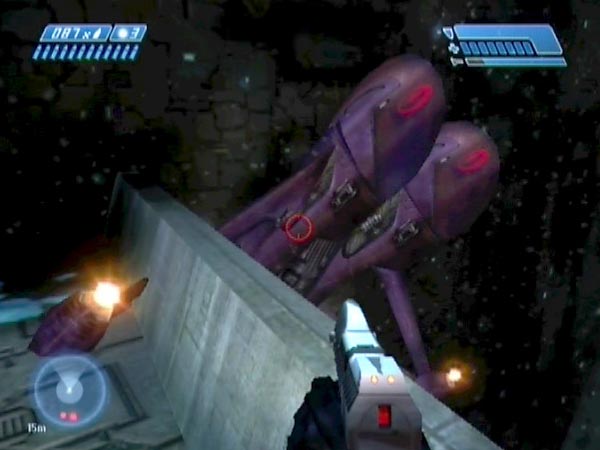
Ejection without entry
Sometimes when the Banshee arrives at the arch gap, it doesn't quite enter. However, it may wobble about and an ejection can follow. You can potentially raise the chance of that by moving to the left of the door (as you face it) to try and encourage the Banshee to angle down after you (it's analogous to the usual countermove), though you'll need to react fast to have much effect.
Early boarding
When the empty Banshee falls, be careful about being underneath. It's certainly possible to board before it hits the ground by mashing the X button, and you can even jump up to try and intercept it, but there's a risk of being squashed, because it'll hit the ground regardless. If you're speedrunning though, such early boarding can save you time. According to my testing, the jumping up method saves about half a second on average, and I think the risk of being squashed is quite small. If you instead wait on the ground underneath, the average saving is only around a quarter of a second and I think the risk of getting squashed is more significant.
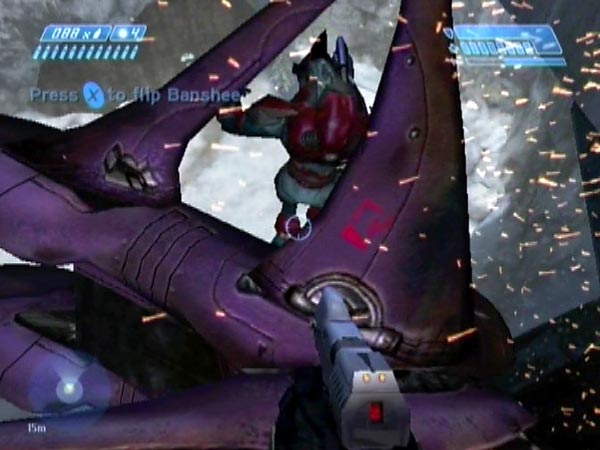
Handling the ejected pilot
The ejected pilot can potentially open fire quite quickly if he doesn't get squashed by his own Banshee or go over the edge. If you're not planning to board immediately and get him with the Banshee (splattering is often quite easy), you may like to have a plasma pistol ready to stun him then finish him off. A plasma weapon is certainly a better option than a pistol, especially on Legendary. You could switch to it as the Banshee is circling to the arch. Be cautious about using a grenade as there's a danger the Banshee could get blasted off the bridge. However, that's mostly only a danger if there are any dropped plasmas which could get detonated. I tag the pilot quite often actually, as it's good fun.
If you want to keep the Banshee in tip-top condition, obviously you should kill all nearby covies before boarding. Don't forget about the patrolling Elite either, who could zap you as you fly off.
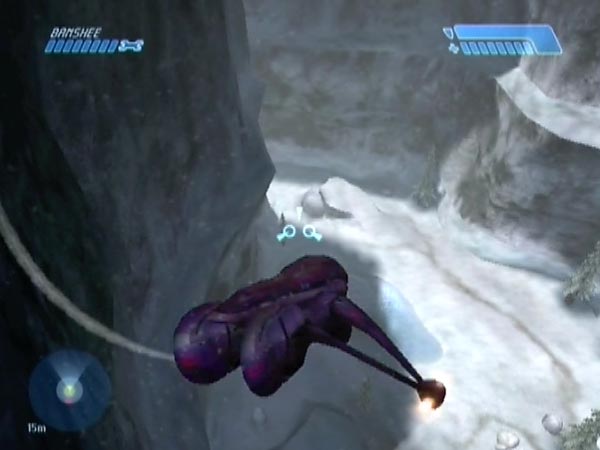
Using a checkpoint
If you're not on a speed run, or if you want to set things up for some practice, the thing to do is get a handy delayed checkpoint for making tries. The pre-bridge checkpoint is triggered in the second section of the passage leading to the bridge, and that's the one you'll be delaying. If you want varied enemy configurations (I'm especially thinking of the Grunts), delay it until just before the loading point, so no enemies have spawned yet. The loading point is near the end of the long middle section of the passage, as you probably know.
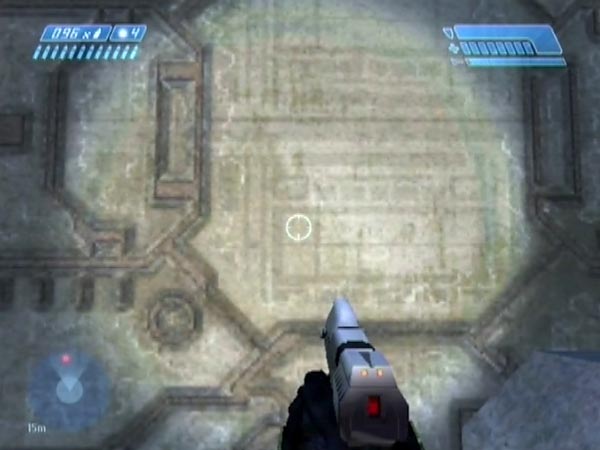
To instead have the same enemy configuration every time, delay the checkpoint until past the loading point; e.g. standing at the door. To also minimize the amount of time per try and avoid hearing Cortana's long "Interesting…" line on retries, get the checkpoint just after she's started. If you do a jump on the spot when you reach the door, that'll probably be enough, bearing in mind that the delay will continue a little after you land. With a late checkpoint like this, failed tries typically won't take more than about 15 seconds - about 7 seconds less than when using a checkpoint before the loading point. You'll need to get into position promptly though, because you'll have a few seconds less. Indeed, you're cutting things quite fine.
Let me warn you of a few dangers when going for a late checkpoint. The checkpoint mustn't get delayed too long, or the Banshee will have progressed too far along its scripted flight path for the method to work (the Banshee needs to still be a long way off when it spots you). Also, if you delay too long or get too far forward, you might not get the checkpoint at all, because the game considers you under enemy threat.
More on the method
Here are some additional remarks on aspects of the arch method, including some talk about earlier versions and the breakthrough.
Wider positioning viable
In regard to your positioning, I specified a very small down-aim target. The plan can actually work with a wider area, but I did a lot of testing and I've chosen the part which was giving the best rate of getting the Banshee to enter the arch gap - which is the critical thing.
No close Grunts
If all the Grunts are on the far side of the wall when you arrive, it may be a good idea to fire a shot before the Banshee gets close, to panic them. The hope is that they'll panic long enough to never bother you. I haven't done a proper test to try and verify that this is statistically the best plan (actually, there would also be the issue of what's the best time to fire), but I suspect it is.
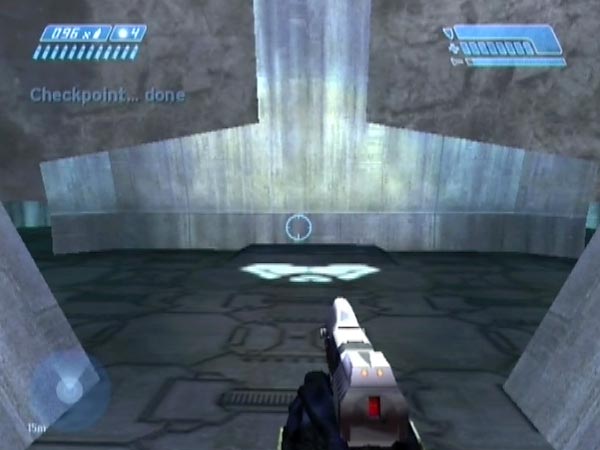
Arriving Grunts
On Legendary, arriving Grunts are significantly more dangerous than on Heroic, so it's more important to avoid having them shoot at you for long. If you decide to use a grenade, a frag can be preferable to a plasma because it goes off sooner. If I know the Grunt is going to be pointing his turret my way before I have time to deal with him, I'll have a frag ready.
With a post-loading-point set-up, sometimes you get to learn that an arriving Grunt can just be ignored. I've had at least one such set-up in which an arriving Grunt would just watch me for quite a while (you can see him in BCM190 around 2:56), and then he'd board the Shade and usually focus on the Pelican!
Grenading a Shade clear
In my accounts of earlier versions of the method, I mentioned the option of grenading a Shade clear (the one on the right of the bridge) so it can't get in the way when the empty Banshee falls. Actually, I eventually came to the conclusion that it wasn't really worth the bother. But with the new method it's even less worth the bother, because the Banshee almost always lands away from that Shade. I don't do it any more.
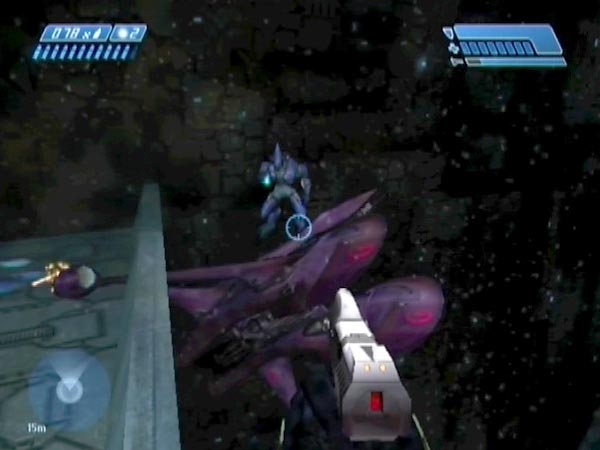
Crouching
If you crouch too early the Banshee tends to arc away (often low). If you're slightly too late, the Banshee may start to circle towards the arch but almost immediately change its mind and veer away. If you're repeatedly seeing either of those behaviours, both of which are shown in BCM191, try to do your crouching slightly later or slightly earlier respectively. There are also times when the Banshee circles into the arch but doesn't hit or enter the gap. Instead it collides with the underside of the sloping beam of the arch. This too is likely to be because your crouch timing was slightly off, albeit not by much.
Make sure your crouch movement is straight down. If you depress the crouch thumbstick in an off-centre way it may cause you to shift position slightly, which can affect the Banshee's course.
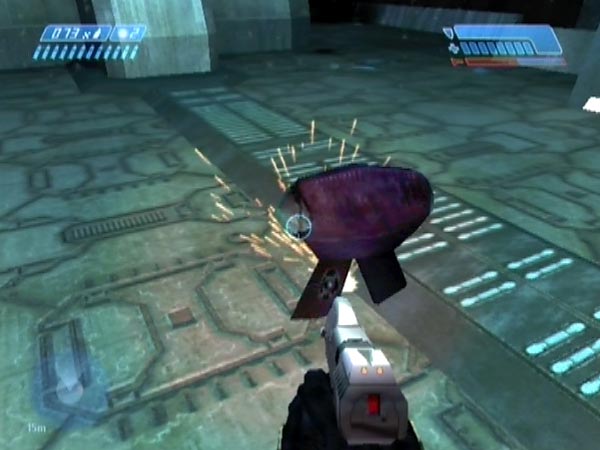
Alternative body angling
When the Banshee is arriving at the arch, traditionally I've been facing the cliff wall (looking up), usually after having watched the Banshee circle around. But in the course of making BCM191 I tried out an alternative style, with body facing the left side of the bridge (again looking up). You can adopt that posture as soon as you've done the crouching and dealt with any Grunt arrivals. Now when the Banshee enters the arch, you'll move left to get nearer the door frame, and then your countermove will be forwards. You may find the countermove easier to do like this.
One-move variation
Talking of different styles, I've also tried causing ejections without first moving in towards the door. In other words, you remain where you are until the Banshee starts angling down, then you do a countermove to try and strain it. It's certainly viable but my conversion rate wasn't as high, so I do think moving in is best. You might like to try it though.
Minimal randomness
Contrary to my early impressions when I got into this arch business, I think there's very little randomness in the Banshee's flight decisions, in regard to its flight after you crouch. Possibly even none at all. That's good because it mean your success rate is largely down to your skill.
Earlier versions, and making the breakthrough
Here I'll talk a bit about earlier versions of the arch method, and the breakthrough.
In my segmented PAL speed run BCM176, I killed the Grunts then quickly positioned myself at a certain spot behind the wall, then made the Banshee veer off at the right moment by making a short forward movement to briefly obscure myself. However, it took a great many tries to work, and it was quite a busy routine to manage. I subsequently honed a more controlled routine designed to minimize random elements, to try and get the best possible control over the Banshee; and as a bonus, Grunt handling became easier too.
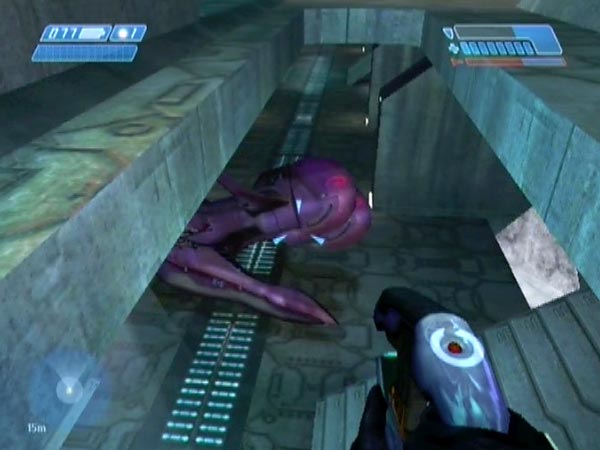
The result felt viable enough for use in an actual speed run, so I went ahead and did one, shown in BCM177. In neither of these movies did the Banshee fully enter the arch gap however. The nose went in, but then the Banshee wiggled about and the pilot popped out. Indeed, I hadn't yet put an emphasis on getting the Banshee to fully enter the gap. The goal was less specific, and in my description I merely talked of the Banshee having 'trouble' at the arch, and wanting it to go "at least part way into the gap".
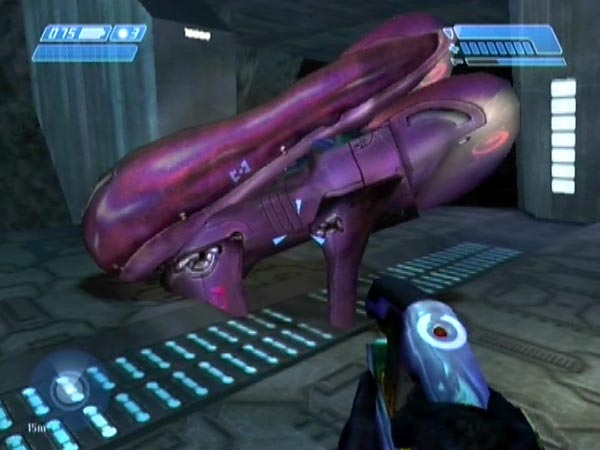
I never did make a tutorial for that more controlled routine, because there were aspects I still needed to check into. In particular, I needed to test whether there was actually any point in doing weapon fire when below the Banshee (I thought it was helping to get the pilot's attention). Towards the end of making my Pelican descent ride movie BCM190, I did that and concluded that there wasn't. In fact I seemed to do better without firing - probably because I was paying more attention to my movement and positioning. It became clear that the pilot was very aware of me down below, and was highly responsive in some regards, which encouraged me to experiment. That's what led to the breakthrough. I hit on a movement pattern and it was giving me success after success. I was in control at last. In retrospect I'm sure a lot of the ejections I'd got previously were because I was doing something akin to that movement, but without realizing what exactly was happening. If I hadn't been distracting myself by firing up, perhaps I would've made the breakthrough a lot sooner!
Compared to the previous version, the new method has three key differences. Firstly, slightly different initial positioning, making it more likely for the Banshee to fully enter the arch. Secondly, no pointless firing when the Banshee is in the vicinity of the arch. And thirdly, a far higher rate of converting arch entries into ejections, thanks to a specific response designed to strain the Banshee.
Never happened before?
What surprises me is that apparently nobody happened to get the Banshee via arch trouble before - or at least nobody reported it, as far as I know. Surprising because, any time you're holding back behind that wall at the start, there's a chance the Banshee could end up having trouble at the arch, and the pilot could pop out. Probably most players don't hang back much, but still, think of the huge number of times the level must've been played!